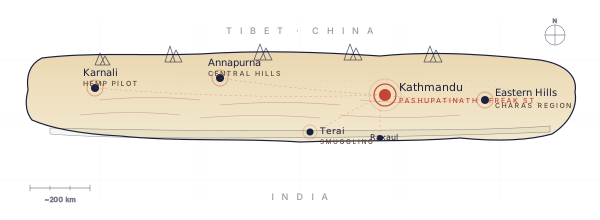
Terai, hills, mountains: one plant, three climates.
Cannabis climbs the same altitudinal gradient as the rest of life in Nepal. The story changes every three hundred metres of elevation, and so does the crop.
Illustration · HashNepal editorial · CC BY-SA
A sadhu with chillum, Pashupatinath, Kathmandu · Photo: public domain
Some nights the river fog carries the smell of hashish all the way to the temple steps.
Pashupatinath · Kathmandu
Chapter I
Sacred Roots
Period
Pre-modern · still observed at Pashupatinath on Maha Shivaratri
Status
Sacred, religious, devotional, public during one annual festival
The smoke rises. The sadhu watches it go.
This is a small ritual. A clay chillum, a thumb of resin, a match struck against the fold of his blanket. The breath that follows is not for pleasure and not for show. It is an offering, to a god who, tradition says, wandered the world cold and hungry and took the plant into himself for warmth.
In Nepal the plant has four names. Bhang is the cool milk drink, passed from hand to hand at festivals. Bhango is the leaf, ground and mixed. Ganja is the flower, smoked in clay pipes. Charas is the resin, the dark, hand-pressed ovals that travelers in another century would come to call temple balls. Each name is a different use. Each use is a different kind of prayer.
The most visible expression survives in plain sight. Once a year, on the night of Maha Shivaratri, devotees gather at Pashupatinath in their hundreds of thousands. Sadhus, ash-smeared, dreadlocked, almost naked in the winter cold, smoke publicly. The smoke is not a transgression. It is the point.
That single night, when the state looks away and the ritual resumes at full volume, is the one tolerated exception to today's prohibition. It is also a living fossil: a reminder that, in living memory, the entire year used to look like this.
“Each name is a different use. Each use is a different kind of prayer.”
The Kathmandu Valley with the Himalaya in the distance · Photo: Wikimedia Commons, public domain
Before 1973, there was no cannabis question in Nepal. There were fields, shops, and taxes.
Central Hills · Annapurna
Chapter II
The Open Door Era
Period
Pre-July 1973 · most of the 20th century up to that point
Status
Legal, licensed, taxed, openly cultivated and sold
The plant had been cultivated in the hills for as long as anyone could remember, often alongside mustard, millet, and maize.
The midslopes of the central hills and the ridges around the Kathmandu Valley produced charas that locals pressed by hand. Cultivation was a household and village activity, not a clandestine one.
In towns, licensed vendors sold cannabis products openly. The government collected revenue. There was no moral panic, no enforcement apparatus, and no stigma attached to the trade heavier than the stigma of selling tobacco.
Foreign travelers who arrived in Kathmandu in the 1960s encountered an unfamiliar ease. A place where the plant they were told was dangerous was sold across the counter like any other crop. That ease was not a quirk. It was the default, the way the country had run itself for generations.
Jhochhen Tole ("Freak Street"), Kathmandu, c. 1976 · Photo: Tony Wheeler
By the early seventies Kathmandu was on the road from Istanbul to Goa, and the road ran straight through a hashish shop.
Jhochhen Tole · Kathmandu
Chapter III
The Hippie Trail & Temple Balls
Period
c. 1965 – July 1973 · peak 1967 – 1972
Status
Legal shops closed overnight; an underground economy took their place within months.
Setting
Jhochhen Tole ("Freak Street"), Kathmandu
Product
Hand-pressed Nepali charas: "temple balls"
By the late 1960s, Freak Street was on every map that mattered to the people who needed it.
Jhochhen Tole, a narrow lane of about two hundred metres in central Kathmandu, held perhaps thirty hashish and ganja shops at the peak. Most were licensed. A few were tolerated. The Raju Hashish Centre was the most famous, with a hand-painted sign, a bicycle parked outside, and a stockroom out back that, by report, held Nepali charas stacked like fruit in crates.
The customers were European, North American, Australian, Israeli. They came overland from Europe through Turkey and Iran, or flew into Delhi and took the bus up. Some stayed for weeks. Some stayed for the rest of their lives. Almost all of them, at some point, sat in a wooden-fronted shop on Freak Street and bought temple balls by the tola, the local unit, just over eleven grams.
The vendors were often second-generation. Their parents had grown the plant on the central hills; they had learned to press it by hand, then to grade it by scent and colour, then to package it for a foreign clientele who had no idea what they were looking at. The best grade, dark, soft, sticky, smelling of incense and pine resin, became known abroad as temple balls. The name was theirs. The product was theirs. The trade was legal.
For about five years, the arrangement worked. The state licensed the shops. The shops sold the product. The travelers spent money. Kathmandu had a tourism economy; no one called it a crisis.
The highest grade was called Royal, already a rarity by the late 1970s. Most of what reached Western travelers was Madras or Medium. The grading was intuitive: dark and soft meant fresh resin, still full of volatile oils; lighter and harder meant older, drier, less potent. A good tola of Royal could be traded among travelers for the price of a meal in a tourist restaurant. A bad tola of Medium could be had for the price of a cup of tea.
Kathmandu street scene, 1970s · Photo: Tony Wheeler
In July 1973, Kathmandu revoked the licenses. The government did not announce a moral campaign. It simply stopped issuing the paper.
Kathmandu · July 1973
Chapter IV
The Ban
Period
July 1973 → September 1976 → today
Status
Core prohibition still in force under amended Narcotic Drugs (Control) Act 2033.
The timing was not coincidental.
The early 1970s were the high-water mark of the United States' war on drugs, and Nepal, heavily dependent on foreign aid, treaty-bound by the 1961 Single Convention on Narcotic Drugs, moved to bring its legal regime into alignment. American pressure, direct and indirect, was a factor. So was the optics of a U.S.-aligned government publicly licensing a hashish market while American soldiers were dying in a neighboring war over narcotics.
In July 1973, the government of Nepal formally revoked all licenses to cultivate, buy, and sell cannabis. The shop windows on Freak Street closed in days. Some became tea houses. Some stayed empty.
Three years later, in September 1976, the Nepali parliament passed the Narcotic Drugs (Control) Act, 2033, the statute by which the country still governs cannabis, with amendments. Cultivation, production, sale, possession, and consumption were made criminal offenses in all their forms. A trade that had been legal, taxed, and exported overnight became a criminal offense.
The economic cost was real and immediate. Tourism revenue from the trail collapsed. Hill farmers who had grown the crop for generations lost their legal market overnight and were left with two choices: stop growing, or grow in hiding. Most chose the second.
The act has been amended multiple times since. Its core prohibition has not.
Hands stained with charas resin, Nepal · Photo: public domain
The law was not a wall. It was a sieve.
Mid-hills · Humla · Jumla · Dolpa
Chapter V
Underground Decades
Period
1976 – 2024 · forty-eight years of prohibition without eradication
Status
Illegal but persistent; hill farming adapted, supply chains moved deeper into the mid-hills.
For half a century the law was on the books and the plant was in the ground.
The hills did not stop growing charas. They grew it differently. Fields moved further from motorable roads. Pressing moved indoors. The trade moved across district lines, then across provincial ones, then across the open border with India. By the late 1980s the centre of gravity had shifted from Kathmandu's Jhochhen Tole to the mid-hills of Humla, Jumla, and Dolpa, remote districts where state presence was always thin.
The Narcotic Drugs (Control) Act was enforced unevenly. Big cases made the press; small cases were settled locally. A kilo of charas seized at the border was a news story; a kilo pressed on a kitchen floor in Dolpa was a quiet transaction between neighbours. The result was not a black market in the Western sense, it was an older economy that had simply moved one layer deeper into illegality.
For hill farmers, the calculus was simple. The crop grew itself. It required no inputs they did not already have. It paid better, per kilo, than anything else they could grow on a steep south-facing slope. The penalty, if caught, was a fine and a warning the first time, and a criminal record the second. Most never reached the second time.
Tourists who arrived in the 1990s and 2000s heard different stories depending on who they asked. The official line was that Nepal did not produce significant quantities of charas. The unofficial line, in certain Thamel teahouses and on certain trekking routes, was that the product was everywhere if you knew the right people. Both lines were true. The sieve was working as designed.
Sadhus gathered during a Shaivite festival, South Asia · Photo: Wikimedia Commons
Once a year the rule does not apply, and once a year the country pretends it has always been this way.
Pashupatinath · Bagmati
Chapter VI
One Day a Year
Period
Maha Shivaratri · night of the new moon in Phalguna (Feb–Mar)
Status
The one tolerated public exception to prohibition.
The day begins before dawn, and the smoke begins before the day does.
Pilgrims start arriving from every district, walking for days or being bused in from across the Terai. The Pashupatinath complex, otherwise a quiet temple complex on the Bagmati river, becomes a city inside a city. The sadhus come first. They have been coming for weeks, from the holy places along the Indian Ganga, from the ashrams of Varanasi, from the caves of Mount Kailash. By the eve of Shivaratri, every square metre of the river bank is occupied by a sadhu in marigolds, in ash, in saffron robes, in nothing at all.
The sadhus are the point. They are the living fossils of a tradition the rest of the country has, by law, abandoned for the other 364 days of the year. They smoke. They pour bhang from brass lotas. They chant, push, shove, and pose. The press photograph them. The state does not intervene. The police, a visible presence on the perimeter, do not enter the inner ghats.
It is, again, a living fossil: a reminder that, in living memory, the entire year used to look like this. The rule does not apply for one night. The country pretends, for that night, that it never really applied at all.
By the morning after, the ghats are empty. The sadhus have moved on. The smoke is in the river. The next Shivaratri is three hundred and sixty-four days away.
Industrial hemp field with the Himalaya beyond · Photo: public domain
The plant the act tried to erase is back in the policy conversation, with a different name and a different pitch.
Karnali Province
Chapter VII
The Hemp Revival
Period
2024 – present
Status
One provincial law in force (Gandaki, certified 3 August 2026); the federal government says it cannot be implemented without federal assent; medicinal legalization now official federal policy. Three open questions remain: who grows, who sells, who decides.
In 2024 a province began asking a different question about the same plant. Before the year was out, the federal government did too.
Karnali, Nepal's poorest, most remote, most depopulated province, announced a pilot framework for industrial hemp cultivation. The framing was careful. The plant was hemp. The THC content was below 0.3 percent. The end uses were fibre, seed, oil, and grain. None of it was for smoking. None of it competed with charas. None of it touched the Narcotic Drugs (Control) Act.
The economic case was straightforward. Karnali's mid-hills are some of the best hemp-growing land in the world. The crop grows well at altitude, requires no inputs, and has a deep domestic market in textiles, food, and construction. The Kathmandu Post estimated provincial GDP uplift at four percent within five years if the pilot scaled. The Asian Development Bank projected substantially more.
What began as one province's pilot became, within two years, a national conversation. The federal government committed to medicinal legalization in its 2024 budget. Gandaki drafted a bill. In July 2026 Gandaki passed the first cultivation law any Nepali province had enacted. The province chief returned it, citing its clash with the 1976 federal act; the assembly passed it again, 32 votes to 25; on 3 August the bill became law. The federal Home Ministry answered that the 1976 ban still binds and Gandaki cannot implement the law without permission from the centre. The pace has no precedent since 1973. The direction is now contested. A dated docket of every reform milestone appears at the end of this chapter.
The cultural argument is louder than the economic one. The hill farmers who have grown the plant for generations, under prohibition, under pressure, under the constant threat of confiscation, are being told, for the first time, that their crop is legal again. The same hands. The same slope. A different line in the law.
The federal act has not changed. The 1976 statute still classifies cannabis as a narcotic, and at the centre industrial hemp sits in a grey zone, technically permissible but legally ambiguous, defined by content rather than plant. The draft Cannabis (Regulation and Control) Act, 2025, and the related Bill to Regulate and Manage Cannabis Cultivation 2076 B.S., would resolve the ambiguity at the federal level. Both are pending. The provinces have stopped waiting.
Until the federal act changes, the revival is a commitment, a patchwork of pilots, and one provincial law the centre says cannot take effect without its permission. Karnali will grow. Gandaki has legislated. The central hills will watch. The conversation, for the first time in fifty years, shifts from whether the plant is allowed to what it is allowed to be.
“The same hands. The same slope. A different line in the law.”
Policy Docket
Nepal’s cannabis-reform milestones, by date. Each row is dated and tagged by jurisdiction and status, so you can see at a glance what has passed and what is still pending.
Updated
21 Aug 2026
FederalAnnounced
Finance Minister Wagle backs regulated cultivation
Finance Minister Swarnim Wagle tells parliament the Ministry of Finance is ready to facilitate regulated cannabis cultivation and that a law is under discussion, calling medicinal legalisation reasonable; he repeats the position on 9 September. Cannabis received no mention in the FY2026/27 budget.
17 Aug 2026
GandakiAnnounced
Gandaki seeks federal facilitation; licences months away
Chief Minister Surendra Raj Pandey asks the prime minister to facilitate implementation of the new law. He later says drafting regulations will take four to six months, and that cultivation licences require a committed industry buyer.
3 Aug 2026
GandakiPassed
Gandaki's cannabis act is certified into law
Province Chief Bhatt certifies the bill and the act enters into force: a 0.3% THC ceiling, three-stage licensing, five-year licences, and fines of Rs 50,000 to 500,000, with recreational use still illegal. The federal Home Ministry responds that the 1976 act prevails and Gandaki cannot implement the law without federal permission.
24 Jul 2026
GandakiPending
Province Chief returns the bill; assembly passes it again
Province Chief Dilliraj Bhatt returns the bill, citing drafting discrepancies and its conflict with the 1976 federal act, the first bill ever returned in Gandaki. On 31 July the assembly re-passes it without amendment, 32 votes to 25.
Nepal enters the present with the oldest narcotics framework in South Asia and the youngest population in the region, and, for the first time since that framework was written, a federal government on the record promising to reform it. The May 2024 budget committed the state to legal medicinal cultivation. In July 2026 Gandaki became the first Nepali province to pass a cultivation law; that August the law took effect over the federal government's objection. Federal legislation that would replace the 1976 ban has been drafted but not enacted. The centre still prohibits; the provinces have started not to. Three questions follow. Each one is unresolved.
Who gets to grow?
The hill farmers of Karnali have grown the plant for generations, under prohibition, under pressure, under the constant threat of confiscation. They want a crop their parents and grandparents grew to be legal again. The federal act still calls it a narcotic. Gandaki calls it hemp. The farmer on the slope does not care about the word. He cares about whether the police come at harvest.
Who gets to sell?
The tourism operators of Thamel remember a Kathmandu that hosted the overland trail. They want to host the same travelers their parents and grandparents hosted. A regulated market could bring them back. An unregulated one already has, informally, with all the risk that implies. The question is whether the law catches up to the market or the market keeps moving past the law.
Who gets to decide?
The 1976 act was written for a kingdom on a single party list, with one foreign-aid donor, and one acceptable position on the international narcotics convention. The country that rewrites it will be a federal republic with seven provinces, each able to pass its own laws, and a generation under twenty-five who have grown up in a country that does not, in any obvious way, do drugs, and who are starting to ask why the law says what it says.
There is no clean answer. There is a province betting on fibre. There is a festival that proves the law bends. There is a diaspora of travelers who remember a Kathmandu that no longer exists. The plant has been in Nepal longer than the law. It will be here after the law is rewritten, in whatever form. The conversation will continue with or without new legislation. Who gets to shape the answer is the part still open.
“The plant has been in Nepal longer than the law.”
End of Chapter VII
fin
Field Guide
Three words, one plant, many uses.
The plant the West calls "cannabis" carries at least three names in Nepal, each tied to a different use. Bhang is the cold, often milk-based drink of leaves and stems, consumed during Shivaratri and Maha Shivaratri by millions who would never identify as users. Ganja is the dried female flower, smoked in chillums or rolled with tobacco, the everyday recreational form. Charas is the resin hand-rubbed from the living plant, the famous Nepalese "hashish," once shipped west by the kilo through history.
What follows is a working glossary for the reader. Where a chapter uses one of these terms in a specific cultural sense, the term is glossed in-line rather than in a footnote.
The plant outlasts every regime that has tried to control it, colonial, royal, republican, transnational. The next chapter is being written somewhere between a Rolpa hillside and a Kathmandu co-working space, and we have not yet read it.
Bhang
Leaves and stems ground into a cold drink with milk, sugar, and spices. The festive form, blessed during Shivaratri.
Ganja
The dried female flower. Smoked in chillums, rolled with tobacco. The everyday recreational form.
Charas
The resin hand-rubbed from the living plant and pressed into balls. The famous Nepalese “hashish”, the form that built Freak Street and bankrolled entire hill villages.